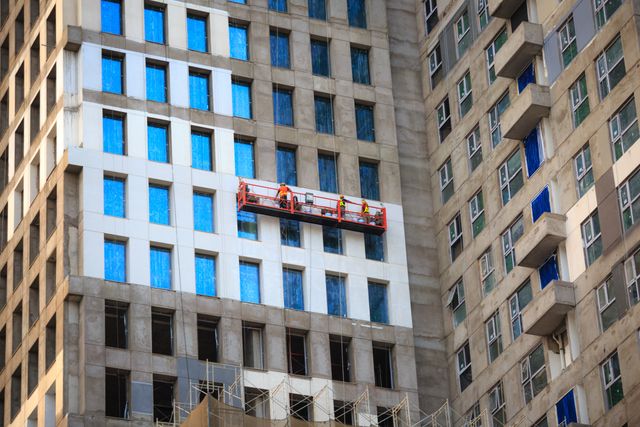
A typical large-block cladding remediation programme runs to £1 million to £5 million in construction cost and another 20 percent on top in VAT. On a 14-storey 60-flat block the VAT alone can be £400,000 or more. Practitioners and trade commentary in 2024 and 2025 frequently referred to a "cladding remediation VAT relief" and to zero-rated treatment for qualifying works on buildings over 11 metres. The reality is more sobering: no such general relief exists in the statute or in HMRC's published guidance. The default VAT treatment of cladding remediation works on existing residential buildings is standard-rated at 20 percent.
What did change in 2022 was the framework for who bears that cost. The Building Safety Act 2022 Schedule 8 protects qualifying leaseholders from cladding remediation costs (an absolute carve-out at paragraph 8) and creates a statutory waterfall of liability starting with the original developer. The leaseholder protection operates on the cost-bearing side, not the VAT-rate side: where leaseholders are protected, the £400,000 of VAT on a £2 million cladding programme falls on the developer or freeholder (or is recovered through the Building Safety Fund), not on leaseholders. Where leaseholders are unprotected, the VAT-inclusive cost flows through the service charge under the usual LTA 1985 framework. This page sets out the actual VAT position, the BSA 2022 protections, the cost waterfall, and a worked example on a 14-storey block.
The Default VAT Position: Standard-Rated 20 Percent
Construction services to an existing building are standard-rated at 20 percent under the VATA 1994 default. Sch 8 Group 5 zero-rate applies to original construction of dwellings (Item 1(a)) and to first grant of major interest in a non-residential-to-residential conversion (Item 1(b)); neither covers remedial work to an existing dwelling. Sch 7A Group 6 reduced rate applies to qualifying conversions changing dwelling count; Sch 7A Group 7 applies to renovation of empty dwellings after 2 years' vacancy; neither covers cladding remediation on an occupied building. The Sch 8 Note 18 substantial-reconstruction zero-rate for listed buildings has not been read across to cladding remediation. There is no statutory item or HMRC concession that creates a cladding-remediation-specific relief.
The practical consequence is that a freeholder commissioning a £2 million cladding remediation programme will receive contractor invoices totalling £2 million plus £400,000 VAT (£2.4 million inclusive). The contractor charges VAT in the normal way and accounts for it on the contractor's own returns. The freeholder's recovery position depends on the freeholder's own VAT-registration status and the use of the building; for a typical residential freeholder making exempt residential lettings, the £400,000 VAT is irrecoverable and becomes part of the cost passed through to whoever bears the remediation under the BSA 2022 waterfall.
The Narrow Snagging Exception (Notice 708 Paragraph 3.3.3)
The only material exception to the standard-rated default is the snagging rule in VAT Notice 708 paragraph 3.3.3. The rule provides that "snagging (or the correction of faults) is often carried out after the building has been completed. The work forms part of a zero-rated building contract, provided you carried out the initial building work and the snagging forms part of that building contract."
Three conditions must align for the snagging rule to zero-rate cladding remediation. First, the original construction contract must itself have been zero-rated (so the original construction must have been new-build under Sch 8 Group 5 Item 1(a) or qualifying conversion under Item 1(b)). Second, the snagging work must be carried out by the original contractor (the entity that was the supplier under the original construction contract). Third, the snagging must form part of the original building contract, not a separate post-completion contract.
The third condition bites hard in practice. For a building completed in 2010 and remediated in 2026, the original construction contract is long since closed out and any subsequent remediation is necessarily under a fresh contract, even if procured through the same contractor. For a newly-completed building where defects are identified during the agreed snagging period under the original construction contract, the snagging rule applies and the remediation can take the zero-rate of the underlying new-build. The window is narrow.
Building Safety Act 2022 Schedule 8: Who Pays the VAT-Inclusive Cost
The Building Safety Act 2022 came into force on 28 June 2022 and reset the framework for who bears cladding remediation costs in qualifying residential buildings. The Act's central mechanism is Schedule 8, which protects qualifying leaseholders from cladding remediation costs and imposes a statutory waterfall of liability starting with the developer.
The threshold for engagement is a relevant building (a self-contained residential building of at least 11 metres or 5 storeys in height, with at least two dwellings). The qualifying-lease test (section 119) requires a long lease (more than 21 years) on a dwelling in a relevant building, granted before 14 February 2022, where the leaseholder met the residential-status conditions on the qualifying date (the property was their principal home or the leaseholder owned no more than three UK dwellings in total).
Where a lease is a qualifying lease, the Sch 8 protections apply. Where the lease is not qualifying (commercial leases, short residential tenancies, dwellings under 11 metres, leases granted after the qualifying date, leaseholders with portfolios above three properties), the leaseholder is not protected and bears their share of the remediation cost through the usual service-charge mechanism.
The Cladding Carve-Out: Schedule 8 Paragraph 8
The single most important provision in Schedule 8 for cladding remediation is paragraph 8, which provides absolute protection for qualifying leaseholders from cladding-system removal or replacement costs. There is no cap and no waterfall caveat: where the work involves the removal or replacement of any part of a cladding system that forms an outer wall of the building, no service charge can be passed to a qualifying leaseholder for that work, regardless of the leaseholder's lease value, the landlord's net worth, or any other factor.
The protection is on the gross VAT-inclusive cost. A £2 million cladding programme attracting £400,000 of VAT generates a £2.4 million liability that cannot be passed to qualifying leaseholders. Where the developer or freeholder cannot absorb the full cost, the Building Safety Fund and other grant mechanisms exist to cover the gap (subject to grant-application criteria).
The Waterfall for Non-Cladding Costs
For non-cladding building-safety defects (fire stopping, compartmentation, balcony defects, internal building-safety works), Schedule 8 sets out a waterfall of liability with capped leaseholder contributions at the bottom.
- Landlord responsibility (paragraph 2). Where the landlord or an associated person is responsible for the defect (because the landlord was also the developer, or because the landlord's contractor caused the defect), the landlord pays. No leaseholder contribution.
- Landlord contribution condition (paragraph 3). Where the landlord's net worth exceeds a threshold (broadly £2 million multiplied by the number of relevant buildings in the landlord's portfolio), the landlord pays. No leaseholder contribution.
- Low-value leases (paragraph 4). Leases below the value threshold (£325,000 in London or £175,000 elsewhere) pay nothing.
- Capped leaseholder contributions (paragraphs 5 to 7). Remaining qualifying leaseholders pay up to a capped maximum over a 10-year window: £15,000 in London or £10,000 elsewhere by default, rising to £50,000 for leases of £1-2 million and £100,000 for leases over £2 million. The annual cap is one-tenth of the permitted maximum.
- Unprotected leaseholders. Outside the qualifying-lease framework, leaseholders bear their service-charge share without cap.
The protection runs for the 5-year period immediately preceding the commencement date (28 June 2022) plus all subsequent service charges. This means leaseholders who paid service charges for relevant defects between 28 June 2017 and 28 June 2022 may have rights to recover from landlords.
Worked Example: 14-Storey 60-Flat Block, £2.4m Remediation Programme
A north London 14-storey residential block (let us call the freeholder Hartfield Estates Ltd) commissions a cladding remediation programme to remove and replace ACM-style cladding identified as non-compliant. The 60 flats are all leasehold; 48 are owner-occupied long leases granted between 2008 and 2020 (qualifying leases), 8 are buy-to-let leases held by investors with portfolios above three properties (unprotected leaseholders), and 4 are commercial leases on ground-floor retail units (unprotected).
The contractor quotes £2,000,000 plus VAT £400,000 = £2,400,000 inclusive for the works. The work consists of £1,800,000 of cladding removal and replacement (qualifying for paragraph 8 protection) plus £200,000 of fire-stopping and compartmentation works (non-cladding remediation subject to the waterfall).
VAT analysis. Standard-rated at 20 percent on the full £2,000,000 net cost. The snagging rule does not apply (the building was constructed in 2008 by a different contractor under a closed-out contract). No structuring option is available to reduce the VAT rate; the £400,000 VAT is unavoidable.
BSA 2022 Sch 8 analysis on the £1,800,000 + £360,000 VAT cladding works. Paragraph 8 absolute protection. No charge can be passed to the 48 qualifying leaseholders. The 12 unprotected leaseholders (8 buy-to-let + 4 commercial) bear their service-charge share of the £2,160,000 cladding cost (£2,160,000 / 60 = £36,000 per flat-share, so the 12 unprotected leaseholders pay £36,000 each x 12 = £432,000). The remaining £1,728,000 falls on the freeholder or is recovered via Building Safety Fund grant or developer contribution under the Responsible Actors Scheme.
BSA 2022 Sch 8 analysis on the £200,000 + £40,000 VAT non-cladding works. The waterfall applies. Hartfield Estates has a net worth of £18 million and 4 relevant buildings, so the threshold is 4 x £2 million = £8 million; Hartfield exceeds the threshold, so the landlord contribution condition under paragraph 3 is met and Hartfield pays the full £240,000 non-cladding cost. No leaseholder contribution.
Cost summary. Total programme £2,400,000. Hartfield bears £1,728,000 (cladding shortfall) + £240,000 (non-cladding) = £1,968,000 absent grant funding. 12 unprotected leaseholders bear £36,000 each = £432,000 collectively (£36,000 per unprotected lease, the cladding-share burden the qualifying leaseholders are absolutely protected from). 48 qualifying leaseholders bear £0.
Want this checked against your specific situation?
Leave your details and a one-line summary. A specialist will reply within 24 hours, with no obligation. Look out for our text, a quick reply confirms your callback.
Building Safety Levy and Responsible Actors Scheme (Not VAT)
Two adjacent mechanisms operate outside the VAT framework but materially affect how cladding remediation is funded at sector level. The Building Safety Levy is a separate developer levy on new residential construction, intended to fund the Building Safety Fund and remediation activity across the sector. The levy is paid by developers on residential schemes meeting prescribed criteria. From a freeholder's perspective, the levy may be the funding source for a Building Safety Fund grant on a specific building, but the levy does not directly affect the VAT treatment of any remediation contract.
The Responsible Actors Scheme requires major residential developers to sign a contractual commitment to remediate buildings they originally constructed or commissioned where cladding-safety defects exist. Signatories agree to fund and execute the remediation directly. Where the original developer is a signatory and the building is in scope, the developer becomes the first cost-bearer under the BSA 2022 waterfall (without the leaseholders or freeholder needing to fund the works). VAT on the developer's remediation contract is standard-rated at 20 percent in the normal way; the developer bears the gross VAT-inclusive cost.
Recharge Mechanics for Unprotected Leaseholders
For unprotected leaseholders (commercial leases, short residential tenancies, dwellings under 11 metres, leases granted after the qualifying date, leaseholders with portfolios above three properties), the remediation cost is recharged through the building service-charge mechanism under sections 18 to 30 of the Landlord and Tenant Act 1985. The standard service-charge framework applies.
The cost must be reasonably incurred (s.19 LTA 1985). The s.20 consultation regime applies where the cost per dwelling exceeds £250: a notice of intention, a notice of estimates, and a response window for leaseholders. Failure to consult limits the recoverable amount to £250 per dwelling unless the FTT (Property Chamber) grants dispensation. Service-charge accounts must be transparent under s.21B and the standard demand requirements.
The VAT element of the cost is generally irrecoverable by the leaseholder. A residential occupier is not VAT-registered and has no input-tax recovery. A buy-to-let landlord letting on AST is making exempt supplies under VATA 1994 Sch 9 Group 1 and again has no recovery. A commercial leaseholder using the unit for taxable supplies may recover the input VAT on its service-charge if the landlord issues a valid VAT invoice for the recharge, but most service-charge recharges in residential blocks are not issued in a VAT-recoverable form. Practitioners should review each leaseholder's position before assuming recovery.
Common Misconceptions
Five recurring misconceptions in the cladding-remediation VAT area.
"There is a special VAT relief for cladding remediation." There is not. The default rate is 20 percent. Only the narrow Notice 708 snagging rule provides a zero-rate, and the conditions are demanding.
"Buildings under 11 metres get a different VAT rate." They do not. The 11-metre height threshold is a Building Safety Act 2022 protection threshold (it defines a relevant building under section 65); it has no bearing on VAT rate. Buildings under 11 metres remediated at owner expense bear the same 20 percent VAT as buildings above 11 metres.
"Qualifying leaseholders get the VAT back." They do not. The BSA 2022 Sch 8 protection means qualifying leaseholders pay nothing for cladding works (paragraph 8) and a capped amount for non-cladding remediation (paragraphs 5 to 7). They do not receive a VAT refund; the cost simply does not flow to them.
"Building Safety Levy reduces the VAT bill." It does not. The levy is a separate sector-level developer tax that funds remediation grants; it does not interact with the VAT rate on any specific remediation contract.
"Responsible Actors Scheme remediation is zero-rated because it is mandatory." It is not. The Scheme creates a contractual commitment between the developer and government; the developer's remediation contract with its own contractor is standard-rated 20 percent in the usual way. The developer bears the gross VAT-inclusive cost.
A final practical observation. Where freeholders, leaseholders, or developers receive informal advice that suggests a cladding-remediation zero-rate or 5 percent reduced rate is available, the right response is to ask for the specific statutory or HMRC-guidance reference. There is no such reference in the legislation or in published HMRC guidance as at the date of this page. Anyone advising a freeholder to budget at zero or 5 percent VAT should be challenged on the source. The 20 percent default is the planning assumption for any remediation programme until a clear and applicable exception is documented.
Related Reading
- VAT on New-Build Residential Property: Zero-Rate, 5%, 20%
- Property Conversion VAT: Three Reliefs, Two Routes, One Project
- Domestic Reverse Charge for Construction Services: Landlord and Developer Guide
- Landlord VAT Registration 2026/27: When Required, Option to Tax, and Holiday-Let Rules
Authorities Cited
- VATA 1994 Sch 8 Group 5 (zero-rated construction; relevance: original new-build, not remediation)
- HMRC VAT Notice 708 (Buildings and construction; paragraph 3.3.3 snagging rule)
- Building Safety Act 2022 (full text)
- Building Safety Act 2022 Schedule 8 (leaseholder protections)
- Landlord and Tenant Act 1985 (service-charge reasonableness s.19 + s.20 consultation)
- Government Building Safety Fund grant scheme
- Responsible Actors Scheme prospectus